
Harsha is a PhD scholar from Ambedkar University, Delhi. He meditatively seeks to read and write histories of Dalit and Dalit Christian identities, social movements and cultural politick in the Telugu speaking regions. Besides historical thinking he indulges in films, dreams, memories and phantasmic realities.
“On Tuesday and Wednesday, November 12th and 13th, from 11am to 6:30pm sale of Indian lace suitable for Christmas gifts will be held in the Boardroom, Livingstone house, Broadway, Westminster, S.W.1. A large and attractive supply of work has been obtained from the field of LMS in Travancore, India and support of friends is earnestly requested”, reads a column of the ‘The Chronicle of London Missionary Society’ in November, 1929. ¹
‘The Madras Times’ in 1886, speaking of the exhibits in the Kensington exhibition and of lace in particular, says, “the best collection of lace is certainly that sent from Nagercoil”. ²
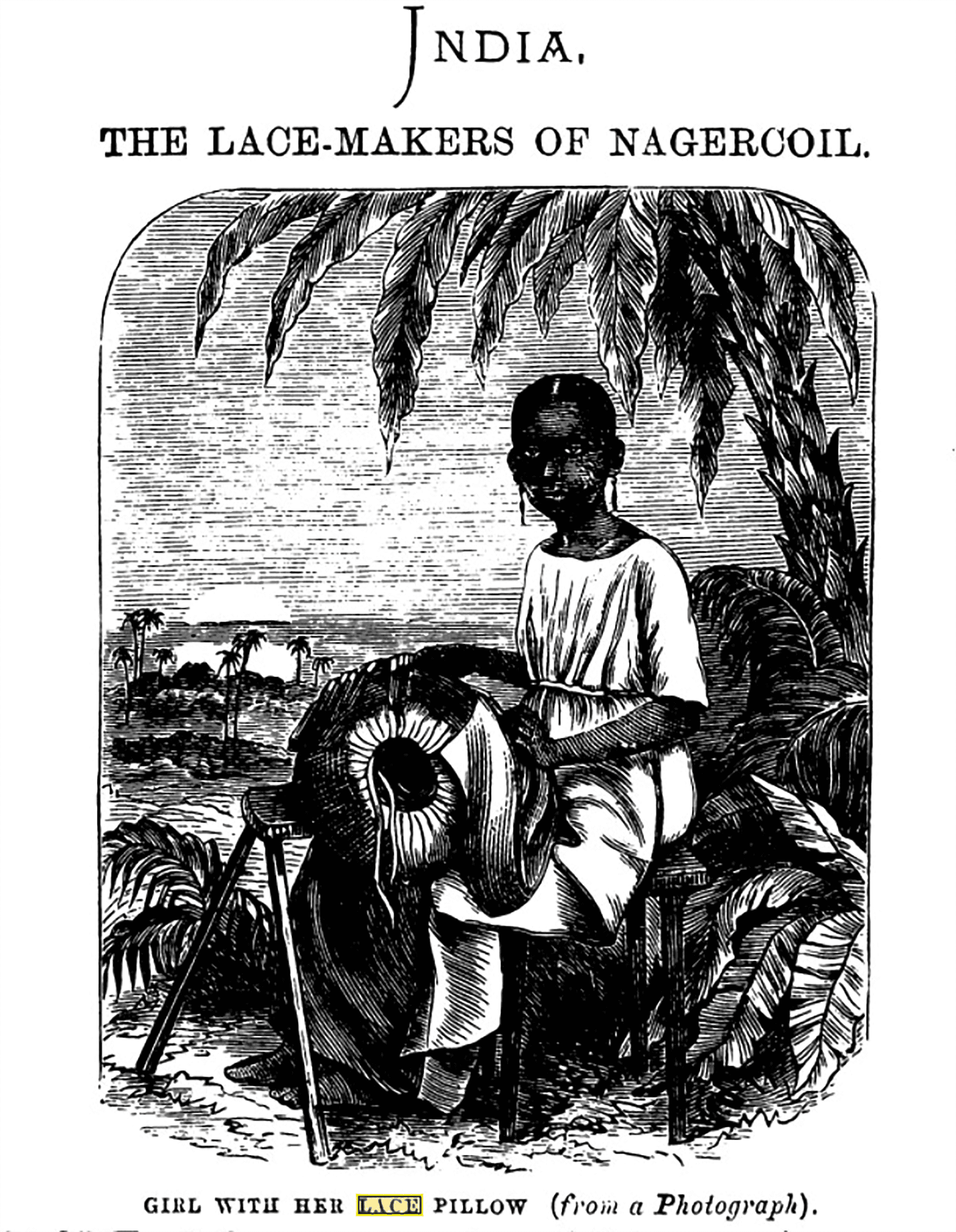
Source : The Juvenile Missionary Magazine, London Missionary Society, June, 1867, SOAS, University of London.
“Some of the young readers of this magazine are, perhaps, looking forward to a visit this Summer to the Paris Exhibition”, reads a column called “The Lace makers of Nagercoil” in a magazine of London Missionary Society called ‘The Juvenile Missionary Magazine’ in June 1867.³ It states that the LMS Nagercoil station has sent various articles from its school museum, and of those, the ‘pillow lace’ was found to be one of the interesting articles at the exhibition. This lace won a medal at this exhibition, as it did at the Madras Exhibition in 1855 and the Great Exhibition held in London in 1851, organised by Prince Albert, husband of Queen Victoria.
The Indian lace that attained recognition globally at these events in Europe and India was actually an article born out of the fingers, hands, and struggles of women belonging to the slave caste⁴ communities like the Parayas and the Pulayas. They are the oppressed castes who were enslaved to perform oozhiyam, or forced labour for dominant caste landlords and the Travancore state in the 19th century Nagercoil district, thus underlining the presence of caste-based slavery in the region dating back millennia. How did women from these communities find and learn the craft of lace making?
*****
The Nagercoil district of South Travancore shared the border with Madras Presidency. Historians opine that these border areas were safer for the slave caste communities to inhabit during the early 19th century— it allowed them to escape more severe caste oppression from the landlords in the northern parts of Travancore. When some LMS missionaries came to Tranquebar in 1806, a Paraya man called Vedamanickam requested that they settle in Mayiladi village and establish a station in Nagercoil. Over the decade, many missionaries arrived in the area and preached to many slave castes, in addition to the lower castes like the Shanars/Nadars, who were the toddy-tapping communities. In 1819, LMS missionaries Charles Mault and Martha Mault arrived in Nagercoil and set up boarding schools for these communities in order to evangelise them. Martha opened a boarding school in 1821 exclusively for girls and began to teach reading, writing, and a peculiar needle craft called lace making.
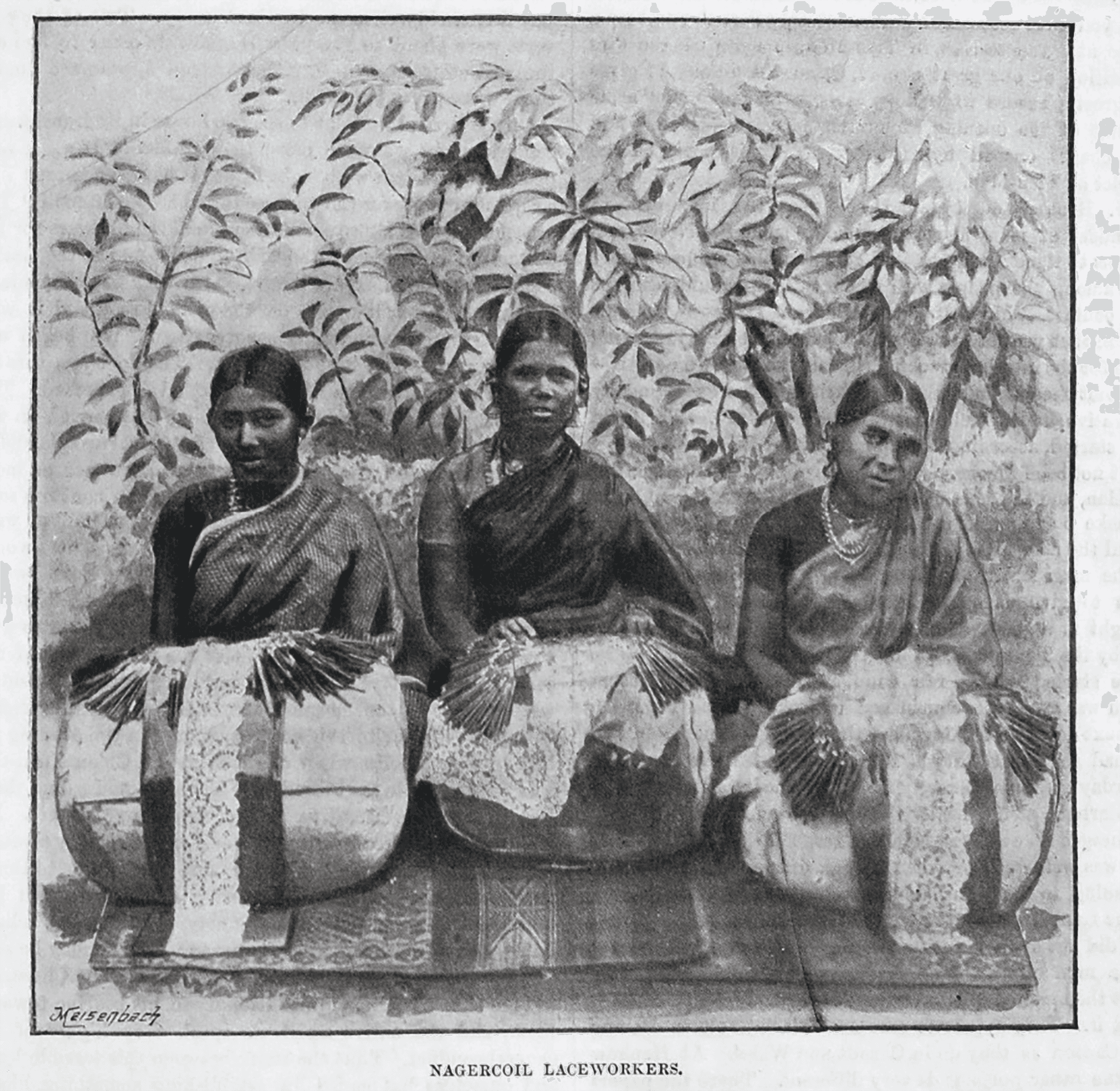
Source : The Chronicle of the London Missionary Society, Feb, 1895, SOAS, University of London.
Lace making is a European tradition generally worked by poor women, for rich women whose bourgeois homes were decorated with lace articles and lace collars, gloves, cuffs, ribbons, etc. The basic handiwork of lace involves a thread and a needle without a background, built into different versions of delicate and decorative fabric. A Lace article contains different patterns of holes coming together as motifs like flowers, leaves, etc and formed an essential part of white people’s dress across Europe.

Source : (1)The Chronicle of the London Missionary Society, Nov, 1929, SOAS, University of London. (2)The Chronicle of the London Missionary Society, Sept, 1919, SOAS, University of London.
A November, 1929 column of ‘The Chronicle…’ details how Mrs. Martha Mault brought the lace to Nagercoil district. It reads, “More than a century ago, slavery existed in the Travancore state, the outcastes who worked on the soil were bought and sold with the land”.
At first, Mrs. Mault wondered what to teach the slave caste women she gathered at the school. When she remembered that her mother had slipped in some lace thread and some bobbins in her bag, an idea sparked inside her head. The village carpenter was immediately called to make bobbins. Straw was brought and filled into hard pillows, pins and cotton were obtained. On the broad cool verandah, mats and all the paraphernalia for lace making and simple torchon patterns that constitute basic geometric designs made of bobbin thread were pricked out.
“When the fieldwork of the slave girls ended at dark, they crept from their fever stricken huts to the friendly home of the missionary.”
The column states that the girls found it hard to bend their fingers to such delicate work, but they loved these free, quiet hours, and a new interest had come into their lives.
*****
In October 1826, a missionary magazine of the LMS called ‘Missionary Sketches’ published Martha’s letter where she writes, “As the friends to Female Education in India have been pleased, through the medium of the society, to contribute for the support of several children in the institution formed at Nagercoil, for the instruction of Native Females”.⁵ She writes that there were 40 children at the school, collected from the “huts of the miserable” and “delivered from the paths of vice and inequity”, and detailed the “degraded and oppressed condition, the mental bondage and cruelty to which the female is doomed”. These words, though couched in a certain missionary language, unveil the condition of the slave caste women who sought asylum at the school.
“The Hindoos consider it disreputable to educate their daughters! This shocking doctrine is taught by their most celebrated legislator, Menu, and the pernicious settlement is inculcated with fatal assiduity by the Brahmins”.
The missionaries rightly attribute the oppressed condition of women and the lower castes to the Hindu laws of Manu Smriti. But the LMS missionaries in Travancore were much more concerned about the visual appearance of the lower castes. The lower caste Shanars and slave caste Parayas, Pulayas and others had to clothe themselves only below the waist and above the knees to indicate visual social difference and inferiority to the upper castes, like the Namboodiri Brahmins and Nairs. This was the sacred rule of law upheld by the society and the King of Travancore, whose power enforced different bodily norms amongst his subjects that underlined a graded hierarchy of caste through visual appearance and clothing.
In 1812, the LMS missionaries influenced Colonel John Munro, the British Resident, to issue an order permitting the Christian women among the lower castes the right to cover their breasts. The Travancore State passed an order in 1814 that granted these women, especially those from the Shanar/Nadar communities the right to clothe themselves, but only through Kuppayam. A Kuppayam is a long sleeved blouse tied in front with a string, and was already prevalent among the women from Syrian Christian and Mappila Communities. In the 1820s, Martha Mault and other missionaries designed a jacket for Christian women, with a long body and short sleeves, fastened in front with a string. This jacket, more commonly called the ravikkey, was made in bulk by girls at the school as supervised by the missionary. The picture of three girls wearing the ravikkey jacket was attached to Martha Mault’s letter in 1826, denoting the wide publicisation of the women’s cause by the LMS missionaries both abroad and at home.
*****
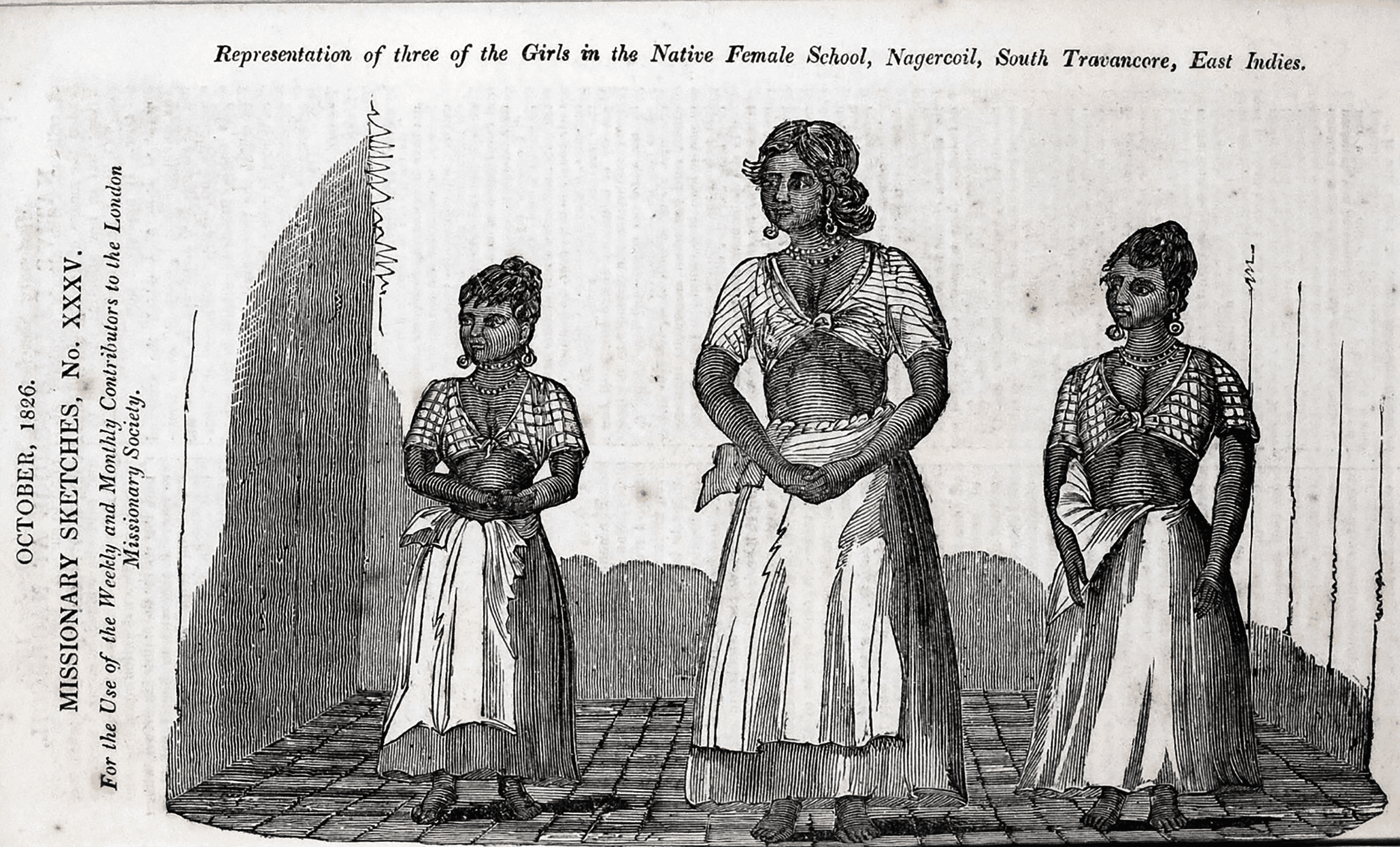
Source : Missionary Sketches, London Missionary Society, Oct, 1826, SOAS, University of London.
Martha’s 1826 letter continues to say that, of the 40 children, 21 are supported by friends and benefactors in England, while the rest depend on the lace industry. This set of girls formed those who made some progress in learning lace, and as soon as they learned to read, they would have to dedicate half their day to working on lace. Martha writes that the Lace School had two objectives. The first was to fund the girls’ school, and the second was to make the slave caste women earn enough from lace work so they could buy their freedom from the landlords. From other letters of Martha Mault, it can be noted that girls from this background were more keenly drawn to do lace work, and by 1830, nearly eight girls had relieved themselves from caste slavery.⁶
There were, of course, some inevitable consequences as the liberated slave girls lost their identity and could not return to their communities. The lower caste communities also found it difficult to part with their daughters, who performed household and agricultural labour and augmented their meagre family incomes.⁷ The girls settled in the mission compound and made lace, attained reading and writing skills, and became village school mistresses in the boarding schools set up by the missionaries across the Nagercoil district. They also married the native agents who worked for the LMS schools in the region. The July 1842 issue of ‘Missionary Sketches’⁸ gives these details, and attached to this report is the letter from the girls at the school named Nallaboothoo, Parimbamoothoo and Fanny, thanking those who supported their education from England,
“Some of us have been redeemed from slavery and now enjoy liberty. All of us have been taught to read the scriptures and we learned to make lace and are able to carry it on in our houses”.
*****
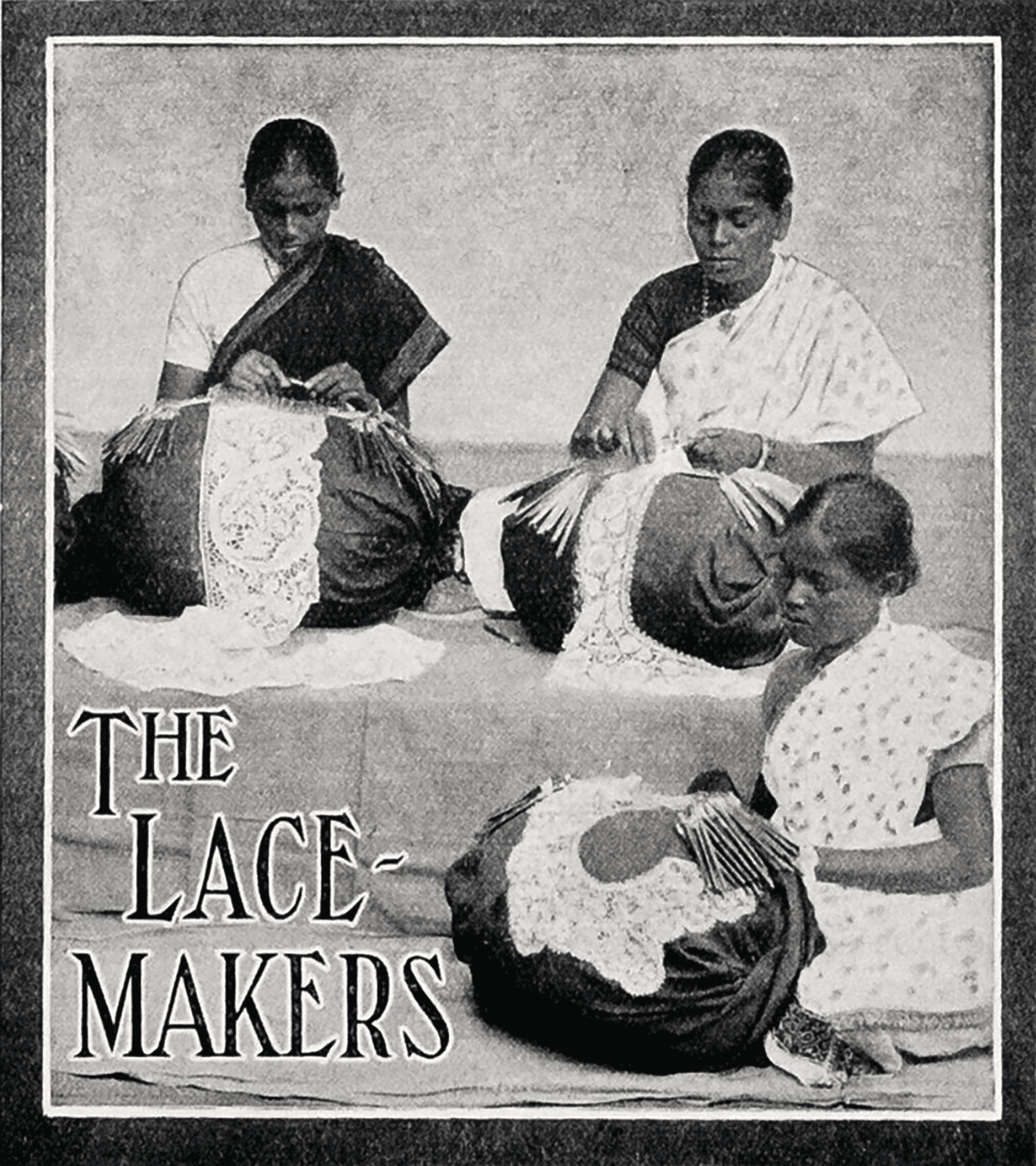
Source : News from afar, London Missionary Society, March, 1931, SOAS, University of London.
The movements of Slave rebellions in the 18th and 19th centuries in the Americas and Caribbean, the pervasive spread of Enlightenment ideals across Europe, and the campaigns of various religious groups in England culminated in the abolition of Slavery in most British colonies in 1833. In 1847, missionaries in Travancore state also referred to the abolition of slavery in the company territories of India and urged the Raja to implement the same. Kooiman writes that the slave holders, upset by the changing economic and political structure of the society, beat up slaves who were receiving aid from the missionaries and drove them out of their lands. Consequently, slavery was abolished in Travancore in 1853. The first half of the 19th century in Travancore society was already a hotbed of revolts by the Shanar/Nadar communities, in their pursuit to clothe themselves equally in the manner of the upper-caste Nairs.
The abolition of slavery and the opening of the free market led to the commercialisation of agriculture and the ushering in of plantation economies across the British colonies. The Shanar communities utilised these opportunities and migrated to Ceylon, and outgrew ranks of cultivation and production in coffee plantations. These changes in the economy pushed the mobility of Shanars upward, and influenced their decades-long movement against the civil disabilities of clothing in the Travancore state. Besides the struggles of the Shanars, petitions from the missionaries and successive British residents affected the Travancore state to issue a proclamation in 1859 allowing Shanar women to cover their upper bodies. The Proclamation did not satisfy the expected ambitions of dignity for the Shanars, as it still disallowed their women from dressing in the manner of dominant Caste Nairs. Meanwhile, the LMS missionaries continued their mobilisation against clothing restrictions, which led to the extension of the Proclamation benefits to all other lower castes, including the slave castes, in 1865.
*****
The chief work of the LMS missionaries in Travancore was education. Boarding schools were carried out for both boys and girls by the LMS missionaries across South Travancore for several decades. The lace industry at Nagercoil emerged out of the success of the craft and the enthusiasm women showed in learning lace at the school since the time when Mrs. Mault introduced lace in the region.
In 1853, Mrs. Mault left Travancore, and other women missionaries took over the lace industry and boarding school at Nagercoil. A matron was employed to teach lace making at the school and based on the orders received, she gave out the patterns to the women. Once the pattern was thoroughly learnt by the women, they were allowed to take the lace to their own homes. Twice a week, they met at the Mission Bungalow, when parchments and materials were given out for new patterns. The lace was made and packed into parcels and sold by missionary women across India.
Friends of the missionaries from London and Europe, who visited Nagercoil, were amazed at the skill achieved by these women, and offered to undertake the sale of lace, both abroad and in India. Wives of important bureaucrats in the British administration, such as Lady Muir of Allahabad and Mrs Cordy of Pune helped to market these products in Calcutta, Simla, etc.⁹ The lace products were also sent to the London Exhibition of 1851, the Madras Exhibition in 1855, and the Paris Exhibition in 1867, where medals were received for the products made by the lace workers of Nagercoil.
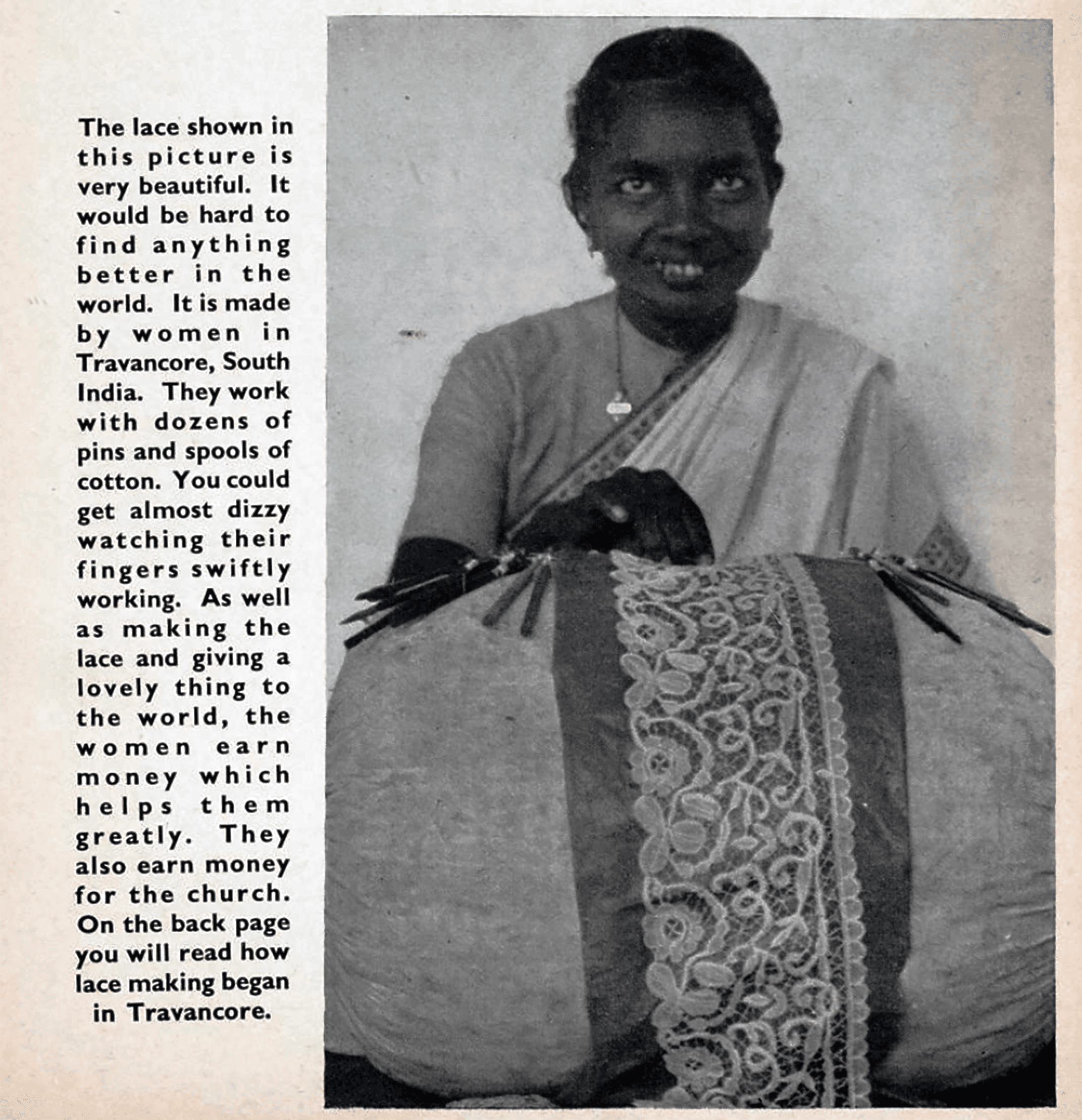
Source : News from afar, London Missionary Society, March, 1956, SOAS, University of London.
In 1894, there were 100 workers in the Nagercoil Lace Industry. By this time, many widowed women had joined the work. Besides narrow edgings and insertions, a wide variety of lace was made by all of them, from pure white lace to gold, silver, and black silk lace. Every Monday was a lace day, and women came with finished products, took their earnings, and went back home with new orders and designs. In addition to the more common patterns, such as Torchon, Cluny, etc., lace workers also produced special kinds of lace, such as Honiton, Duchess, Buckingham, and Brussels, named after the respective places where these patterns emerged.
In October 1894, ‘The Chronicle…’ wrote, “Many of our most intelligent and educated women received their education in schools supported wholly or in part by the lace profits and several schools are similarly maintained by the money thus realised”. Missionary magazines across the latter half of the 19th century attest that the funds brought by the lace unequivocally went to the funding of female education in boarding schools across the district, after the payment of the workers and the Bible women.
In July 1897, Mrs Allan Duthie, who managed the Nagercoil Boarding School and the Lace Industry, wrote that there were 170 pupils and 96 boarders at the school. As for the lace industry, there were 350 workers in the entire district making lace under her supervision. Many women thus continued to make lace at the school, but female pupils also began demanding more skilled education over manual work from the missionaries.
The school constituted an English department with 100 pupils and a Tamil department with 21 girls who were being trained for the primary Teachers certificate. By now the school had risen to the standard of a high school as changes in Travancore state educational policies and grant-in-aid from the government powered the Nagercoil Boarding School. Allan Duthie also prepared 5 girls for the Matriculation exam of the University of Madras and sent them to Maharajah High School in Trivandrum. The boarding schools in Nagercoil also produced many teachers from the slave caste communities, who appeared for special primary education exams and took up teaching in other LMS schools in the district.
*****
“The first great blow to slavery in Travancore was dealt”
“From rice field under heathen masters to independence, able to read and pray and give-” ¹⁰
Hundred years after the birth of the lace industry, LMS missionary magazines began to speak about the glory of Nagercoil Lace and the way it emancipated slave caste women in the Travancore region. During the same period in early 20th century India, an image of a middle aged man dressed in a loin cloth with his chest laid bare, weaving a thread on a wheel, was popularised across the country to boycott British-made goods and promote Swadeshi clothing and thread. Self-sufficiency by weaving khadi thread and dressing modestly was promoted by him to identify with the poorest of the country, and these symbols were centred as fundamental to the Indian freedom struggle.
In February 1937, Gandhi visited Nagercoil, and was surprised that LMS had been running a cottage industry here for more than 100 years.¹¹ His followers asked the workers at Nagercoil to make articles with hand spun Swadeshi Khaddar thread instead of British machine-made lace thread. The Khaddar thread, not being as strong or as smooth and even as English made yarn, broke so often that it took thrice as much time to make Khaddar lace compared to the foreign thread. The women at the industry soon gave it up, and continued to make regular lace.
*****
J. Devika, a feminist historian, contextualises the shifting discourse of clothing across castes and genders in 19th and 20th century Kerala.¹² She writes that while the clothing in the period before the 18th century marked social hierarchies, in the 19th century period of modern reform, it began to signify what constituted the new Individual that imbued the body, and the self with new meanings. These complex changes were affected and ushered in by missionaries, social reformers and Dalit movements that altogether reconstituted the oppressed body into a modern self that agitated against the hierarchy of caste. In the same vein, missionaries derived the ideal female self from the Victorian and Christian virtues of morality and class and transplanted it onto the bodies of slave caste Pulaya, Paraya women and other lower caste women from Nadar communities.
The portrait drawn by the missionaries of these women in the 19th century was that of a doomed figure warranting missionary rescue. By draping their upper bodies, educating them in biblical scriptures and teaching them lace work, the missionaries decided what seemed ‘appropriate’ for these Women. But the Nadars transcended mere missionary designs, and assertively claimed what was the sole preserve of the dominant Caste Nairs and made the body and self a site of struggle.
The slave caste women, on the other hand, embraced new forms of economic agency through lace, and liberated themselves from the enslavement of the feudal authority of the caste landlords. The earnings brought by the sale of their lace products in India and abroad also aided in the proliferation of the women’s education across the LMS boarding schools in 19th and 20th century Southern Travancore region. They demanded higher education from the missionaries in the later period and became Teachers in several educational institutions of the London Missionary Society. The lace workers of Nagercoil thus knitted together not just threads, but also freedom.
References :
¹ The Chronicle of the London Missionary Society, Nov, 1929 https://digital.soas.ac.uk/Documents/Detail/the-chronicle-of-the-london-missionary-society/115094?item=115095, SOAS, University of London, All Rights Reserved.
² The Chronicle of the London Missionary Society, Oct, 1894 https://digital.soas.ac.uk/Documents/Detail/the-chronicle-of-the-london-missionary-society/105256?item=105270, SOAS, University of London, All Rights Reserved.
³ The Juvenile Missionary Magazine, June, 1867 https://digital.soas.ac.uk/Documents/Detail/the-juvenile-missionary-magazine/66116?item=66124, SOAS, University of London, All Rights Reserved.
⁴ Mohan, Sanal P., Modernity of Slavery, Struggles against Caste Inequality in Colonial Kerala, Oxford University Press, Delhi, 2015. The terms ‘caste slavery’, ‘slave caste’ were used by Sanal Mohan in his research, which I have retained in this article.
⁵ Missionary Sketches, No. XXXV, Oct, 1826. https://digital.soas.ac.uk/Documents/Detail/the-chronicle-of-the-london-missionary-society/115094?item=115103, SOAS, University of London, All Rights Reserved.
⁶ Wingfield, Chris, Argonauts of the Eastern Atlantic, Artefactual histories of the London Missionary Society https://argonauts2022.net/14-paramasattee/
⁷ Kooiman, Dick, Conversion and Social Equality in India: The London Missionary Society in South Travancore in the 19th century, Manohar Publications, Delhi, 1989, 78. Kannan, Divya, Contested Childhoods, Caste and Education in Colonial Kerala, Cambridge University Press, Delhi, 2024, 86.
⁸ Missionary Sketches, No. XCVI, July, 1842. https://digital.soas.ac.uk/Documents/Detail/missionary-sketches/126291?item=126295, SOAS, University of London, All Rights Reserved.
⁹ Hepsi Bai, N., Dalit Women Reform Movements with special reference to Social Reform Movements by Christian Missionaries in Travancore, Think India Journal, Vol. 22, Issue. 4., Oct-Dec 2019, 9237.
¹⁰ The Chronicle of the London Missionary Society, Nov 1929. https://digital.soas.ac.uk/Documents/Detail/the-chronicle-of-the-london-missionary-society/115094?item=115103, SOAS, University of London, All Rights Reserved.
¹¹ The Chronicle of the London Missionary Society, Nov,1938. https://digital.soas.ac.uk/Documents/Detail/missionary-sketches/126291?item=126295, SOAS, University of London, All Rights Reserved.
¹² Devika, J., The Aesthetic Woman : Reforming Female Bodies and Minds in Early Twentieth-Century Keralam, Modern Asian Studies, Vol. 39, No. 2, Cambridge University Press, 2005.