Nidhi Suman is a law graduate, researcher, writer, and illustrator from Ranchi, Jharkhand. She works on caste, gender, education, and labor through legal work, fieldwork, and storytelling. Her writing is rooted in lived experience as much as it is in research.
During the long summer months, my paternal grandmother (dadi) would travel from our village in Mirzapur, Bihar, to stay with us in Ranchi, Jharkhand. The heat in the kachcha house had become difficult for her to endure, and my school vacations offered a rare stretch of time for us to be together. Our nights were marked by her stories, the strange, meandering tales that made little sense. As a child, I was captivated by them. In these stories she would tell me about her brothers, her married life, and my grandfather who I had little memory of.
One such summer, I was assigned a holiday homework of making a family tree. Unlike many of my classmates who spoke excitedly of documented lineages and old photographs of their great-grandparents, I found myself with very little to draw from. I remember asking my mother why we had no such records, no images to anchor our past. Her response was brief, almost matter-of-fact: “gareebo ka koi record nahi hota” (the poor leave no records behind).
There have been several such instances in my life where I hold back when talking about my family, the absence of my lineage often feels glaring. Over time, I have begun to understand this silence not as a gap in my family alone, but as something caste produces, as a systematic erasure, of those whose labour is needed but whose lives are not meant to be recorded. In this piece, I turn toward the occupation tied to my caste, tracing it deliberately through my family history, because someone must choose to remember.
The unorganized footwear-making industry has been historically sustained by Dalit (Chamar) communities, my community. The word Chamar itself is associated with leatherworking (derived from charmakara, "skin worker"). My great-grandfathers — as I have been told — were all involved in traditional shoemaking. Leatherwork has a historical link to untouchability and has been the only consistent occupation available to the people of my community since pre-colonial times. The caste system has affected not only the craft of leatherworking itself, but also the sense experience related to the craft, specifically the scent of leather. Caste logic has redefined the scent of leather as repulsive enough to classify leatherworkers as being impure and untouchable.
Our story begins, at least as far back as I have been able to trace it, in Dhaka, Bangladesh. During the colonial period, East Bengal had no large footwear factories; most shoes were brought in from Calcutta (now Kolkata). Small-scale production began only in the early 1950s, when Chinese migrants started making shoes and sandals in the area of Old Dhaka. Bihari refugees and immigrants from India, many of whom had worked in footwear units, learned these skills and began setting up their own workshops.
Both my great-grandfathers were among these Bihari migrants, travelling from their respective villages to Bangladesh in the hope of providing for their families through the bustling shoe industry of Old Dhaka.
I am told it was a common practice back then in our community, we had big families wherein the wives (my great-grandmothers) would care for all their children along with assisting with farming chores to make extra cash. If the families had a son, after entering his teenage years (sometimes before), he would also travel along with their fathers to help with shoemaking business.
After Bangladesh’s independence, when many Bihari families left, Bengali workers took over these units and continued the work. The industry in Dhaka also underwent a lot of expansion in the 80s, it grew not through formal systems, but through migration, skill sharing, and the need to survive.
Post-1971, Bihari migrant workers found refuge in Calcutta, whose prime geographical location made it ideal for sourcing raw materials as well as selling finished products. My maternal grandfather (nanaji) recalls that in the 1970s and 80s, Phoolbagan was home to nearly eight to ten thousand people from the Chamar community, all working to sustain a livelihood in the city involved in leatherwork. There were around 2,000 houses that doubled as shops and workshops, each employing eight to twelve workers who laboured day and night, often sleeping in the same space. Despite these conditions, the community was organised. Local leaders helped resolve disputes and looked after collective welfare. One such figure was my nanaji’s maternal uncle, respectfully known as “Mahashay”. Among the more educated men in the caste, he also played a key role in setting up the Harijan Jagjiwan Vidyapith School in the locality, a school for children from the community that continues to function to this day.
He was also instrumental in helping both my great grandfathers secure rental shops in Calcutta to run their businesses. This, in time, brought the two families into closer contact, eventually leading to my parents’ marriage.
The Ecosystem
In the 1970’s the migrant workers would, after renting a small room for workshop, approach wholesalers who’d give them ₹100-₹200 advance to gather equipments and buy raw materials like rexine, rubber, various chemicals, PU adhesives, heels, insole boards, latex, solution/glue, yarn, soles, stickers and colours. They used traditional equipment: scissors, hammer, sharp knives etc. as tools.
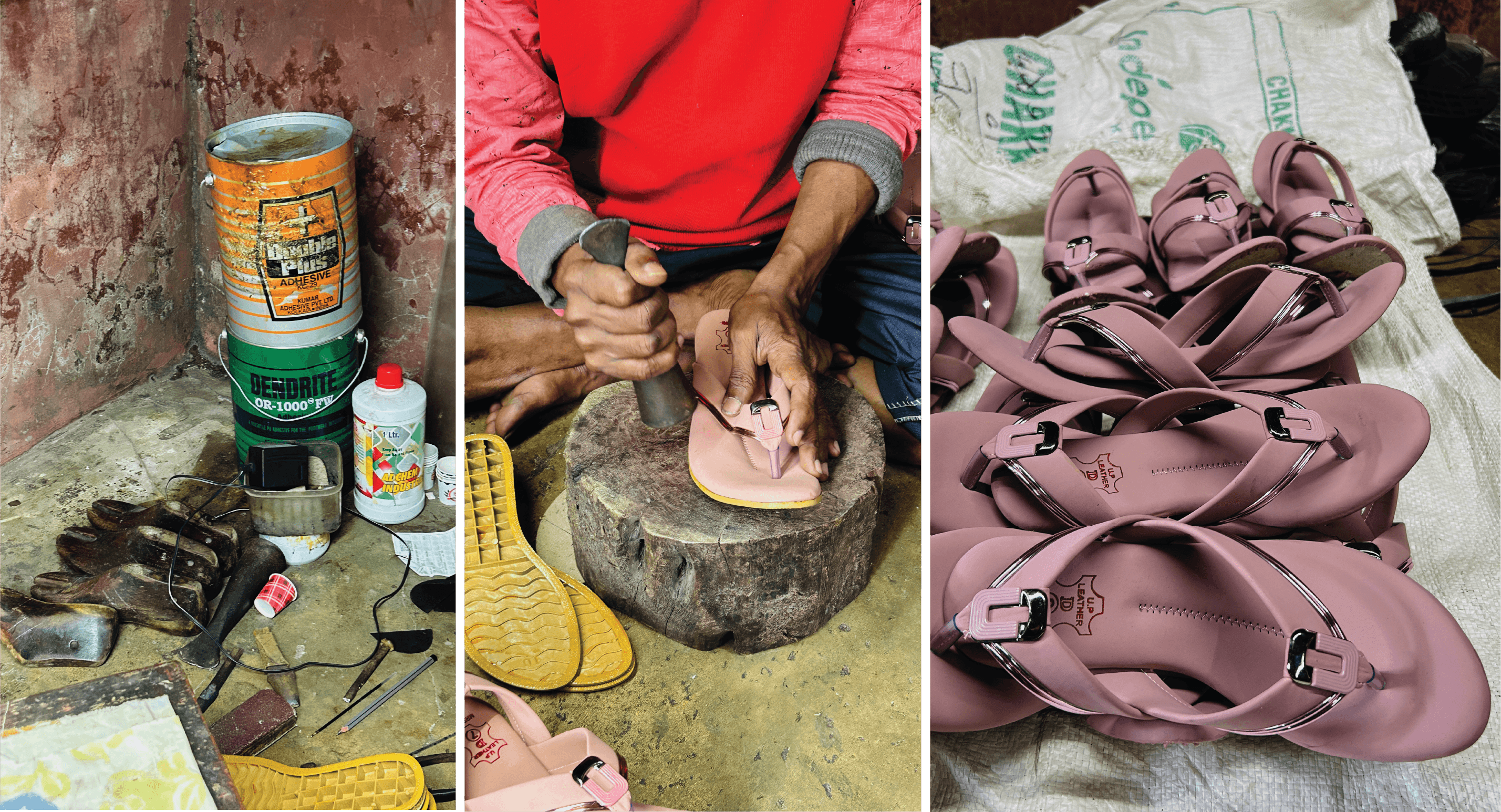
Working equipment used by artisans still remains the same. Picture Credits: Nishant Kumar
These workshops were often single-room spaces with a machaan (scaffolding) above for sleeping and a working platform below which functioned as tightly controlled labour sites. Kaareegars (artisans) were divided by task and were paid according to their skills. The usual process in the footwear industry consists of designing, cutting materials (clicking), stitching the upper parts, lasting (shaping over a foot mold), attaching the sole, and finishing. Each of these workshops typically employed 10–12 kareegars. This included a few errand boys, paid on a monthly basis; about six workers who handled tasks like applying adhesive and other low-skill work; and around four skilled workers who worked on the upper part of the shoe. These workers were responsible for cutting and stitching, which were tasks that required both strength and precision. Through most of the 1970s and 1980s, their wages rarely exceeded ₹4–₹5 for every dozen pairs they made.
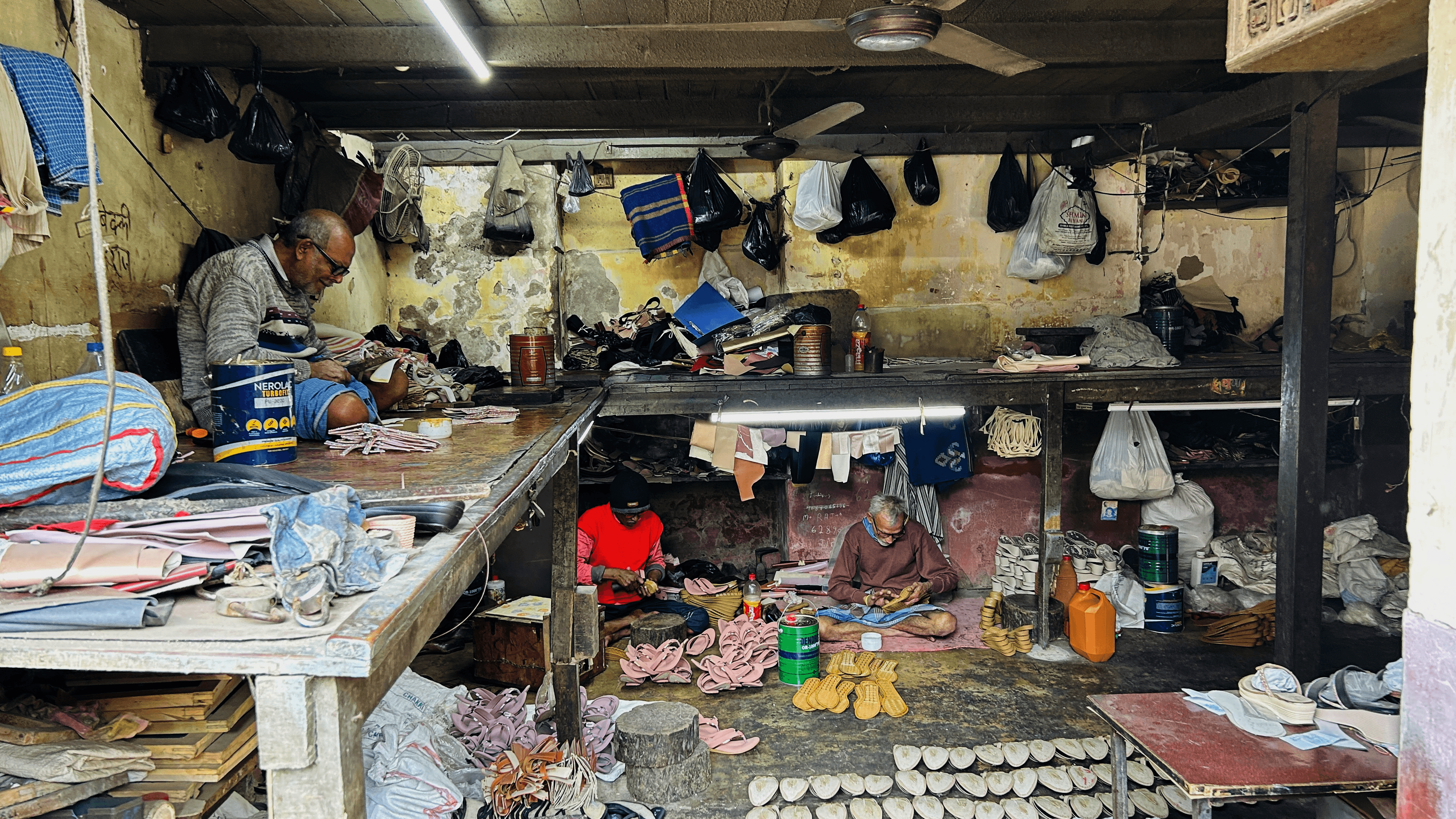
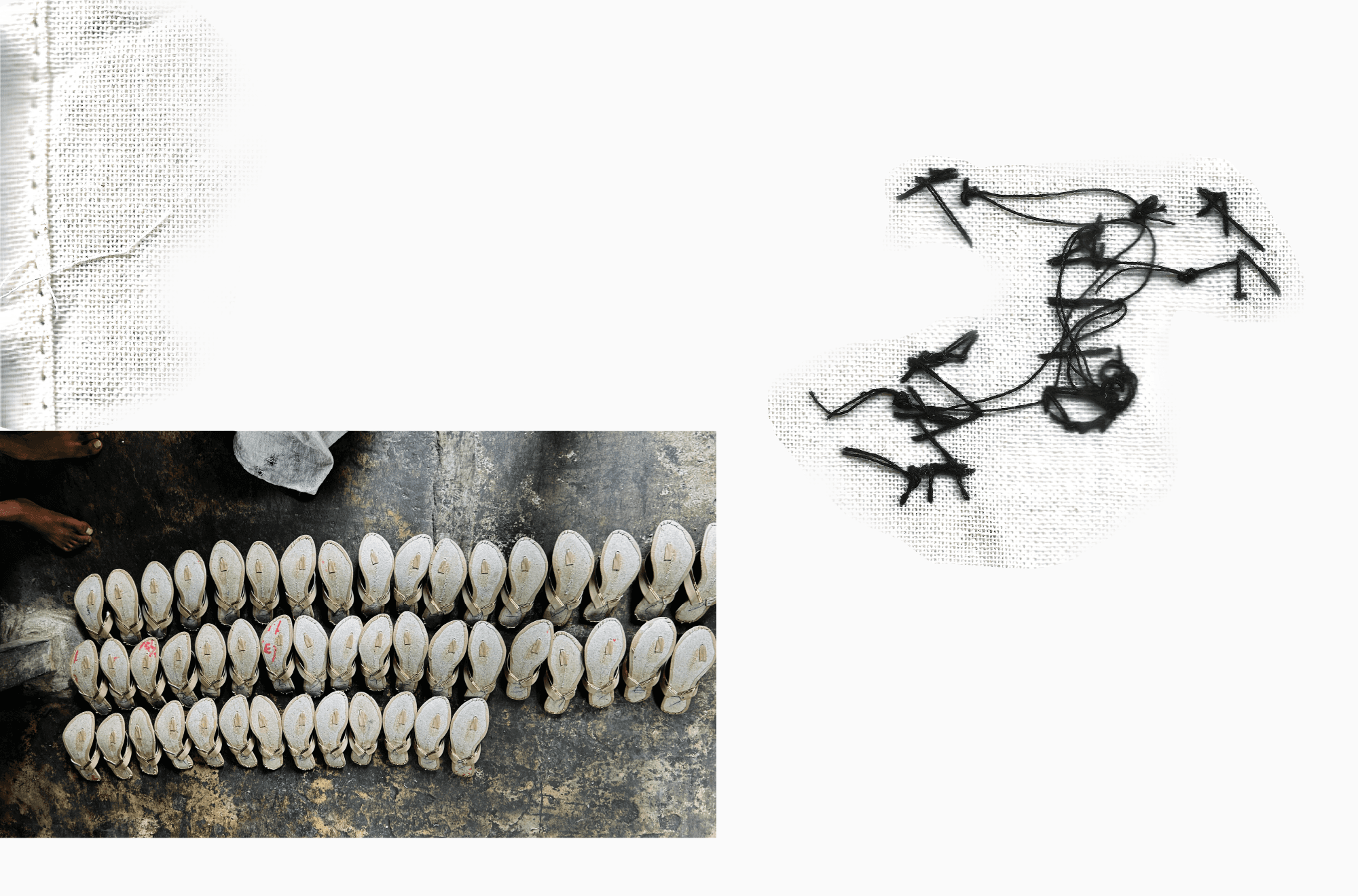
A cramped footwear workshop in Kolkata, Mahatma Gandhi Road where kaaregars sit on low platforms crafting chappals by hand. Picture Credits: Nishant Kumar
Almost all of the workshop owners/supervisors in the area once used to work as labourers and then artisans from a young age. They later themselves trained new workers and later on the workers became skilled kareegars. Despite high levels of skill, margins were negligible; the profits ranged from 50 paise to one rupee per pair, with payments from “wholesalers/factory owners” staggered across deliveries, creating cycles of debt and dependency resembling bonded labour.
A day in the life of a footwear leatherworker began early, often with a cup of chai, and continued late into the night — sometimes until midnight — in the same tightly controlled workspace. In Calcutta’s humid climate, the workers remained drenched in sweat, while the constant handling of raw leather added to a persistent stench that clung to the workshops.
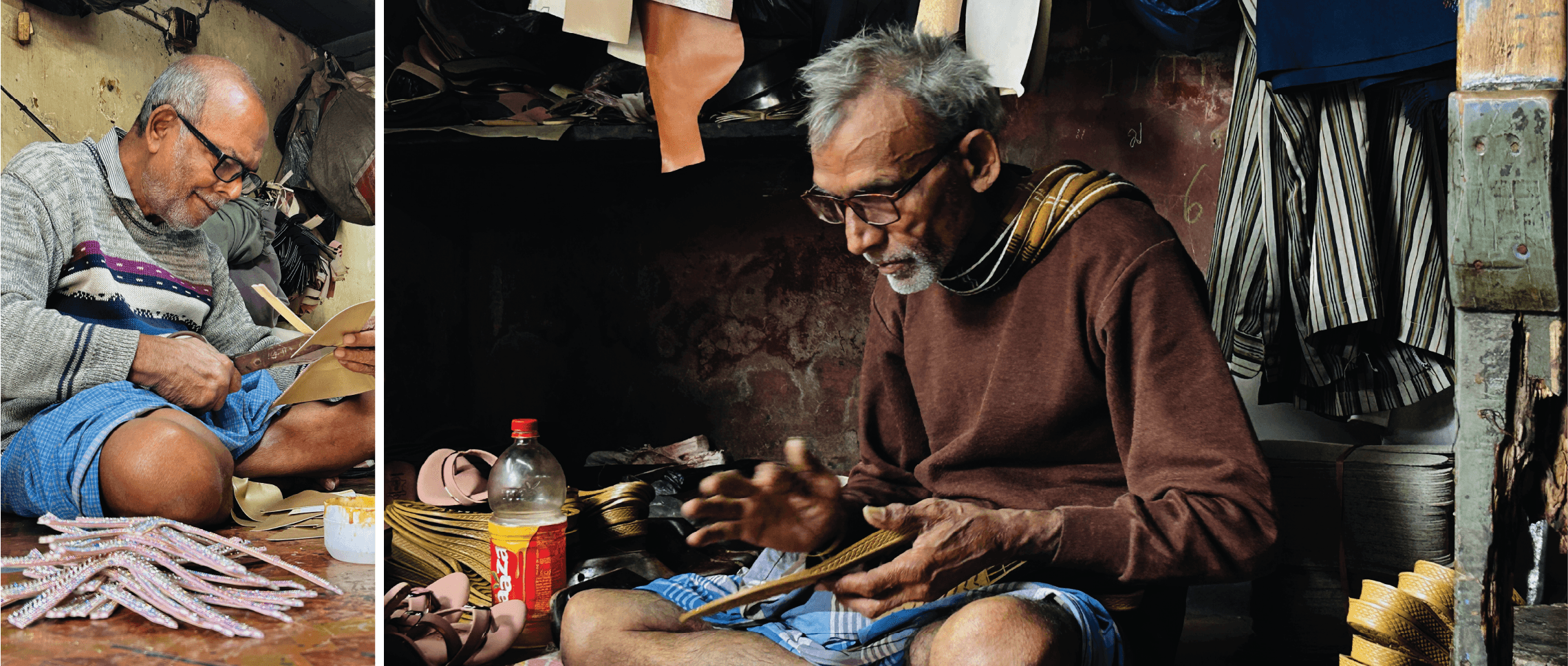
These conditions consisted of long hours, physical strain, and continuous contact with leather, which fed into the upper-caste perception of impurity and untouchability attached to the kareegars. As my mother recalls, their poverty, worn appearance, and lack of formal education further deepened this stigma. With little bargaining power, they were rarely in a position to negotiate fair prices with wholesalers for the products they made.
However, things were not always this bleak. During festive seasons, orders would surge, and with rising demand, sales would increase significantly. Durga Puja was one such occasion when kareegars could earn relatively higher profits. However, due to limited financial literacy, these earnings were rarely saved or invested, and were often spent on immediate needs, and at times, alcohol. Holidays were also non-existent, my dadi often told me that my paternal grandfather (daduji) would return home only once or twice a year, usually for a month at most, and that too around festivals like Chhath Puja. This was common among migrant workers, who would travel back home briefly during Chhath before returning to the city for work. All through the late 1980s, my daduji shouldered the weight of nine children in Mirzapur, faithfully remitting ₹20–30 each month to sustain their lives.
My nanaji came to Kolkata at around six years old, where his father had already set up a small footwear workshop. As a child, he helped with errands and minor tasks in the shop. By the time he finished high school, at sixteen, this involvement turned into full-time work. By then, however, leatherwork carried a growing sense of stigma, and he, as one of the few educated boys in the family, wanted to pursue higher education and move beyond caste-based labour. His brothers, too, were encouraged to study and find more stable, better-paying work.
Back in 1967, he found his way into a factory, earning ₹60 a month all while attending evening college and paying his own fees. After three years, he completed his degree. Although he had stepped away from the family occupation, circumstances drew him back into the footwear business. Managing it alongside two jobs, however, proved difficult, especially as a young parent. The rented shop was later passed on to others within the community and has since been used intermittently for the same work, well into the 2000s.
On the other hand, my daduji laboured from childhood in his father’s shop until his retirement in the year 1997. Unlike previous generations, however, he ensured that both his sons completed their education, and as a result, neither of them followed in his footsteps.
*****
Over time in the early 2000s, the unorganised leather footwear industry in Calcutta was gradually overtaken by Bengali and Muslim communities, particularly with the rise of rubber and plastic-based footwear. These materials did not require handling raw animal leather, making the trade more accessible and less burdened by caste stigma. As a result, many from the community migrated to southern states like Kerala, Bangalore to continue working in the industry.
Even today, some of our extended relatives remain in this line of work. While conditions may not be as harsh as before, they have not improved significantly, and the forms of exploitation persist in different ways.
To write this history is, in some ways, to resist that early lesson — that the poor leave no records behind. What survives in my family are fragments: stories, migrations, skills passed down through labour rather than documents. The footwear my community has made for generations continues to circulate widely, worn without thought, while the lives behind it are consciously invisibilised, erased not by oversight but by the logic of caste. This piece is an attempt to place those lives on record and to acknowledge this labour not as invisible, but as foundational to both survival and the making of everyday economies.
The author would like to acknowledge her nanaji, fufaji, her mother and father, elder sister Neha as well as her dadi, her cousin Shekhar Kumar, Nishant Das and her friends Trisha Beria and Rashi Mohan, whose support, conversations, and encouragement made this piece possible.
References :
¹ The Smell of Caste: Leatherwork and Scientific Knowledge in Colonial India
² Here is how non-brand shoes transformed rural lifestyle | The Business Standard
³ Hope for rebound fades fast for many Old Dhaka shoemakers | The Business Standard