
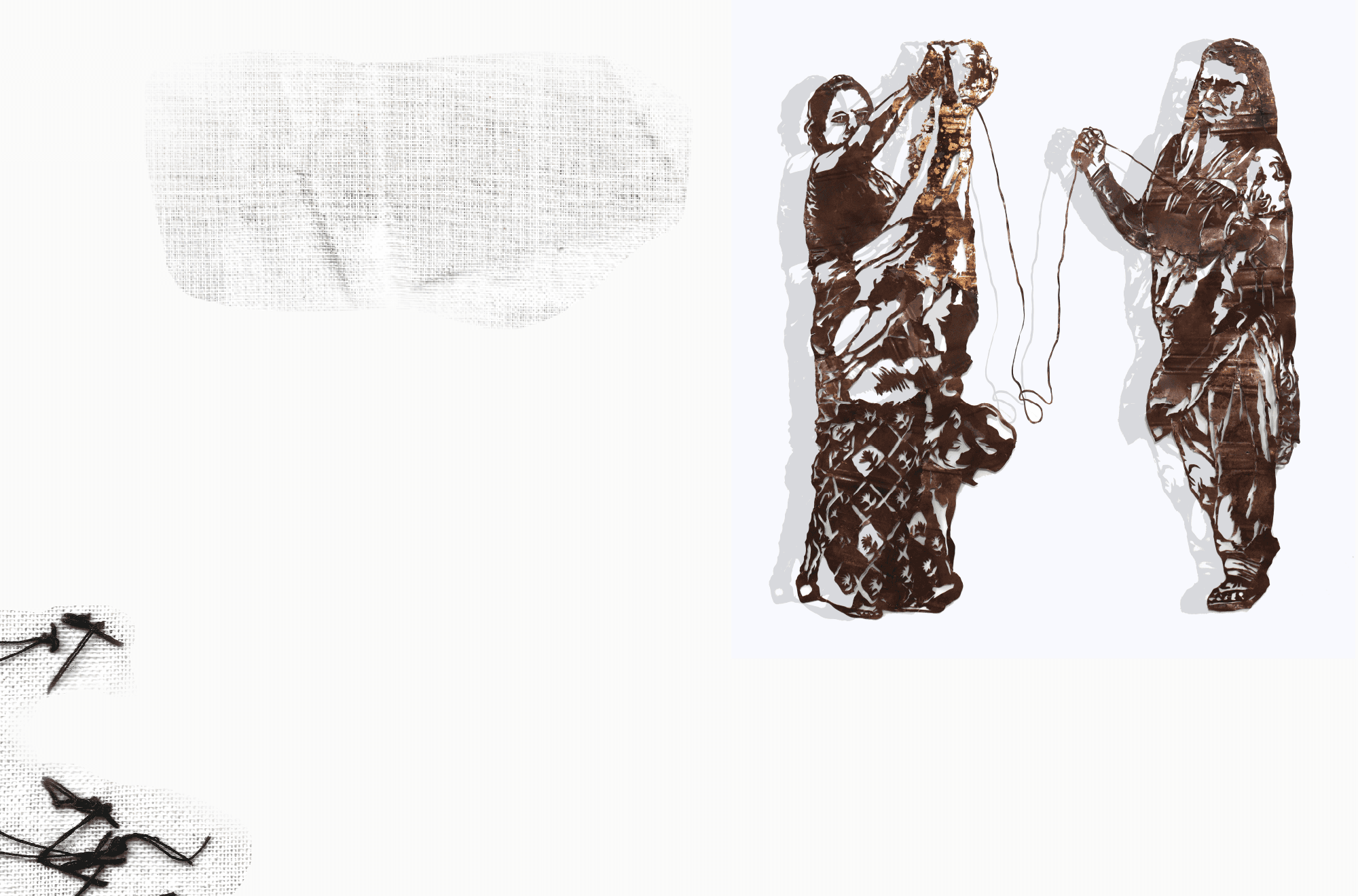
Tamil Nadu Textile and Common Labour Union(TTCU) founding members Jeeva and Poongodi hail from Dindigul district in Tamil Nadu. Both are first-generation learners and long-time garment workers who played a central role in building the union from the ground up. Jeeva served as Secretary of the union, while Poongodi held the position of Treasurer, both helping strengthen the union’s organising, leadership, and worker support systems over the years.
Thivya Rakini is a labour rights expert who has worked extensively with labour and community movements in Tamil Nadu. Hailing from Dindigul, she has helped organise garment workers, fisherfolk communities, and home-based workers across rural regions in the state. She has over 20 years of experience addressing domestic violence, gender-based violence, and intercaste tensions in rural Tamil Nadu, while supporting community-led remediation, dialogue, and reconciliation processes.
The global retail brands’ clothing that urban middle class aspires to buy from, and fashion itself through, is often produced in horrifying conditions by exploited workers, in invisibilised bottom rungs of supply chains of global capitalism. States that have a track record of ‘good’ global commercial partnerships often have the economies of entire towns and districts dependent on facilitating an access to cheap labour in order to enable the production of goods for larger MNCs. Areas around Tiruppur and Dindigul have been apex points for networks of working caste bodies for decades, producing the shiny new clothes we see in shopping mall windows across the world.
The regime sustained by this exploitation requires an easily expendable bioforce with little to no legal safeguards. This has always been Dalit women for the caste society. Tamil Nadu is no exception. The fashion industry runs through a cascading network of local strongmen, corrupt officials, and local politicians who are in the companies’ pockets — all to ensure that the steady flow of Dalit women workers remains intact and unorganized. The formation of the Tamil Nadu Textile and Common Labour Union (TTCU) in 2013 challenged these existing hegemonies. With a majority of Dalit women as its members, including permanent positions in the Union posts reserved for them, the Union seeks to fight for the day to day rights, living conditions, and dignity of the workers. The Union was crucial in the Justice for Jeyasre movement, following the gruesome murder of Jeyasre Kathiravel.
Jeyasre was 20 at the time of her death. She had faced months of harassment on the factory floor by her supervisor, but the lack of any safeguards within the ecosystem meant that her complaints were never heard. She followed a long line of dead or missing Dalit women workers, whose deaths did not matter to the apparatus as it always found ways to bribe or bully its way to preserving the status quo. In this case though, the sustained pressure from TTCU and subsequent global exposure meant that Jeyasre’s death could not be swept under the rug. It became a catalyst for the historic Dindigul Agreement, which enshrined legal rights, safeguards, and protocols against gender and caste-based discrimination within the garment industry. This was one of the first successful steps in the quest for dignity and safety for the Dalit women workers of the area, and as the women behind TTCU profess in the interview that follows, there is a long way to go still.
We interviewed founding members of TTCU, Jeeva and Poongodi, as well as Thivya Rakini, a labour rights expert who has been closely associated with TTCU. In the interview they speak extensively about their journey within the garment industry, the terrible working conditions and discrimination faced by Dalit women workers, the formation and workings of the Union, and provide insights about the days leading to the Dindigul Agreement. We are extremely thankful to them for their incredible clarity and resolve in fighting against enormous odds. Special thanks also to Nandita Shivakumar for facilitating the interview.
Rahee Punyashloka
I’d like to start by understanding a little more about your background — what led you to become garment workers? What was your experience of the work and the industry in the beginning?
Jeeva
I started at the spinning mill out of necessity, I was around 14 or 15 at the time. I needed to take care of the basic needs at home. I needed money. For agricultural jobs, they weren’t taking young girls, but at the spinning mill, they really wanted young girls. I got the job through a travel agent, who knew how desperate young Dalit girls are because of their poverty. The travel agent who took us to the factory would not go to the dominant caste communities, because their parents always wanted them to study. He would only go to Dalit homes. He would make 1000 rupees for every 10 girls he took to the factory. He took a bus of Dalit girls from my colony, and took them to the spinning mill. This man wasn’t Dalit, and he was able to buy three travel vans from the money he made.
My first salary was 50 rupees. I suffered a lot, especially in the beginning. There was so much sexual harassment, and the management would harass us with words that have double meaning. As a 14-year-old girl, I didn’t really understand these words and that they were sexual. It was only later that I fully understood how these men from the OBC community were looking at me and other Dalit women, and it brings me a lot of sorrow, because I know those words were not used with women from the dominant caste.
But I’m very proud now, as I’m entering my 40s, that we built this union because I did not want any young Dalit woman to suffer what I went through in the factory. But even today, I know that people from the dominant caste will be nice to me to my face, but they will never want me in the role they are in. They don’t want Dalit people to be promoted, to be in managerial positions. They cannot stand it. The moment you assert your power, they show you their true colours.
Poongodi
I lost my father when I was 5 years old, and after 10th standard, my mother told me that there’s no money to educate me further. Like Jeeva said, there were no agricultural jobs for Dalit workers. I was told to go to the factory, and a neighbour said it was better than daily wage work because you receive a monthly salary, and it’ll be a big relief for your mother if you can send her some money.
I started going to the mill, only to realise the conditions were terrible. All the things Jeeva has mentioned. The men would touch us inappropriately, and there was no one to support us if we needed anything. There was also caste prejudice, with most of us being from the SC community. If you complain alone, you’ll only face more torture.
Rahee
Thank you so much for sharing that with us. I wanted to know a bit about what led both of you to start and build this union?
Jeeva
I first wanted to build a union when I was struggling with the Sumangali Scheme. This was a major scheme in the Tamil textile industry, where young girls, mostly from the Dalit community, were told that if you work for 3 or 5 years in the factory, the entire payment will be made in bulk after the period ended, so that you can pay your dowry. The government initially favoured it. But this was really a big trap, because you weren’t allowed to even take a leave during that 3-5 year period. Even if there was a death in your family, they wouldn’t leave you. You had to stay in the factory hostel. There was a lot of suffering, we were young girls suddenly torn apart from our families. When we couldn’t meet our parents and families, there would be deaths in the hostel. And there was nobody to speak up for our rights. We didn’t even have that concept.
At this time I met James, who was running an NGO, and he organised a congress of women workers. Here, I realised that women can come together collectively, ask for something collectively, and perhaps actually have our demands met. This was when I understood the concept of a union, that 8 hours of work means 8 hours of work, overtime means double the wages. That I don’t have to be a slave, that I have these rights. When there are deaths in the factory, when there are labour violations, when we have worked 5 years and not got our wages, we can fight for these things.
Poongodi
A specific incident brought me to the union. Around the time James and Jeeva were setting up the union, I had just finished 10 years in the spinning mills. I wanted my PF (Provident Fund), but the factory was unwilling to give me the 10 years of PF. This was my biggest saving. I went to different people asking for help, but nobody could, and it’s at this point I came to the union. Through the union, I got my PF. Since then, I have always wanted to fight for the rights of women workers, and believed that garment workers need their own union. Drivers have their union, why should we women not have our own unions, especially to tackle the issues of sexual harassment?
Thivya
The idea for the union came after Jeeva and James returned from a women’s conference in Istanbul. At that time, the board questioned why another union was needed when many traditional trade unions already existed in Tamil Nadu. But their thinking was that those unions did not really have women membership and didn't share leadership positions with women.
So one of the main principles they brought was that the union should be women-led. Men could be given temporary membership if they had issues, but permanent membership would only be for women. Since around 60–65% of the workers in this sector were Dalit workers, they also decided that the General Secretary and Treasurer positions should always be held by Dalit workers. The union first focused mainly on spinning mill workers because conditions there were very severe, but they also wanted to include allied sectors, so they named it the Tamil Nadu Textile and Common Labour Union.
They also understood the realities women workers faced socially. Many women could only attend meetings if another woman from the neighborhood or family also joined, so they wanted the union to include workers from related sectors as well. They made efforts to bring together women from different caste and religious communities, including Muslim workers, so it would not become limited to only one group or one section of textile workers.
The union started in 2012 and was officially registered in 2013 as a state-level trade union, which took about a year because the authorities had to verify that no other union with the same name existed.
Rahee
Could you speak a little about how caste manifests itself within the factory itself? Are there segregated workstations, or is caste followed in how living quarters are provided to workers? How is the day to day encounter with caste as a garment factory worker?
Poongodi
People in the factories can often identify your caste just from where you come from, and then they treat workers differently based on that. If a Dalit worker raises an issue with a machine, even if it is very dangerous or life-threatening, management may ignore it or keep delaying action. But if the same complaint comes from a dominant caste worker, it gets attention much faster.
I have personally seen this difference in treatment. This is also because most of the senior positions in the industry are held by dominant caste people. Since there is no reservation system in private industries, and dominant caste workers often have networks of family or community connections in management, they support each other. Dalit workers do not have the same kind of representation or support in the higher levels.
Jeeva
Technically, garment factories do not officially collect information about caste. But the moment a worker says they are from a particular colony, people immediately identify them as Dalit, and that is where the discrimination starts. Even if someone is educated and has a degree, once management knows their background, they are often pushed into the lowest kinds of work, like cleaning jobs, instead of being given opportunities matching their qualifications.
This discrimination comes both from management and from dominant caste workers inside the factory. Workers from dominant castes usually sit separately, do not mingle with Dalit workers, and even avoid sharing water or common spaces with them. In some cases, if a Dalit worker has used a bathroom, others will avoid using it and wait for another one instead. So caste segregation continues very openly in everyday factory life.
Thivya
Factories always say they do not practice caste because they do not officially collect caste information, but caste is present everywhere inside the factory system, like Jeeva and Poongodi have explained. That is why, in our union, we keep caste categories in the forms. This is not to practice casteism, but to make sure Dalit workers have representation and equal power-sharing in leadership positions.
Rahee
Are there any official codes of conduct, even if only on paper, against caste discrimination that the factories would publish for protocol? Have there been any formal safeguards that are present in theory, if not in practice?
Thivya
As the other two will attest, they have never seen any of these codes of conduct. They didn’t know it had ever existed, none of the Dalit workers know about it. Whenever they have taken up the issue of caste, the factory’s response is “This is a community problem, why are you bringing it in the factory?” They say the community is geographically structured like this, and make it like an objective fact.
Until Jeyasre’s case, we never thought we could win in these situations. There wasn’t really any awareness of the brands and their codes of conduct. It was only through exposure to external actors during this case that the workers realised that these rights could be codified.
Rahee
Could you please speak about the days of the Jeyasre case? I believe all three of you were working very closely with Jeyasre’s family to ensure their safety and also to put pressure on the authorities to take action. How was the climate around Jeyasre’s death different from previous instances where Dalit women workers have died under similar circumstances?
Jeeva
I have personally seen three to four deaths of Dalit women garment workers, and in one case I even saw the body of a woman who had hung herself in the factory bathroom because the working conditions were so horrible. When a Dalit woman worker dies, the factory goes to the local caste panchayat or local strongmen, negotiate with the family, give some money, and tell them to stay quiet and not take the issue further. In Jeyasre’s case, it became different because she and her mother were both members of our union, and their village had been organized with TTCU for many years. Also, since I was both her relative and a union leader, we were able to push the issue further and take it to brands and international attention.
Initially, the factory behaved the same way as always. Not even one senior management person came to the house to offer condolences after her death, which is also the norm. But after the issue reached organizations and the Guardian reported on it, they realized they could not quietly settle it. Even then, they created tension within the community, putting some Dalit men in jail over this, trying to use the men to control the women.
The management came to the house late at night, after 10 PM, claiming they wanted to offer compensation, offering money to try and force her to sign documents. Even though the mother was in deep grief and repeatedly said she did not want to sign anything. They still tried to force her thumbprint onto documents saying she accepted the money and had no complaint against the factory. Because they did not realize I was also a union leader, I was able to secretly record the whole incident and share it as evidence to show that the agreement was forced and not given with consent. We had no money or resources compared to the factory, but what we had was meticulously collected evidence, and support from a larger network that helped us hold them to account.
Thivya
From 2014 to 2025, during my time in the union, TTCU directly handled 39 death cases of garment workers. Out of all those cases, Jeyasre’s case was the only one where I can say we achieved something close to justice, because the compensation fully reached the family. Usually, when a worker dies, even though workers already receive PF and ESI benefits, any additional compensation for management negligence gets controlled by caste groups, political party people, and local leaders who claim they can “manage” the family. So even if the factory pays 5 or 7 lakhs, after all these people take a cut, the victim’s family may finally receive only around 1 lakh. That is why I say this caste-based leadership do not really protect their own community people; mostly they protect their own interests.
In Jeyasre’s case, around 50 members from caste-based political groups were brought in, and many of them were supported by the management itself. They were aggressive to Jeyasre’s family, they were even denied access to water from the public tap in the village. We had to keep the family safely inside the union office for many days while fighting the case. Legally also, the factory escaped responsibility by saying the death did not happen inside the factory premises, so the police said no direct case could be filed against the factory. But through constant work day and night, and a lot of tears, we brought success. Compared to the previous cases, this case became very important because it forced management and brands to actually sit up and acknowledge, be sensitised towards caste and its cost, and that they cannot ignore it anymore.
Poongodi
In an earlier death case at one of the mills I had asked the victim’s family to work with the union instead of going through VCK, because the union would make sure the compensation fully reached the family. But the family believed the political party and Dalit male leaders would have more power to negotiate. Later, I heard that most of the compensation was taken away, and the family received very little. So when Jeyasre’s case happened, the union was worried the family might again choose political groups over TTCU.
But this time, Jeeva already knew Jeyasre’s mother well, and TTCU immediately stood with the family from the beginning, helping during the search for the body and staying with the mother at the hospital. We told her to trust the union, even though they were women, and promised to fight properly for the family. The mother and father finally trusted TTCU, which was very important because gaining the community’s trust itself was difficult. This was an especially difficult case because society and even the police treated it as a Dalit woman “running away” with a dominant caste man. At the police station, officers even told the mother that this was expected to happen. Thivya strongly confronted the police for speaking like that. Thivya was a huge ally and support for us in this fight, and gave us a lot of courage.
Thivya
By the time the body was found, it had already decayed for five days. The police were not allowing us to see the body, saying it was a female body without clothes and nobody could go inside. But I did not listen, I just rushed in. When I saw the body, I could see that her lips and chest had bite marks. That was what made me become very aggressive about the case, because even if she had gone with someone in a love affair, that does not mean he had the right to kill her.
After seeing the body, I came out and noticed a factory person coming from the police inspector’s room while we were being stopped. At that time, many people were trying to discourage us, saying the place where the body was found was far from the factory and brands could not be held responsible. But the way I saw her body, and the condition she was in, gave me the strength to withstand all the retaliation and pressure that came afterwards. That was what kept me fighting till the end of the case.
Rahee
How you stood up against the immense pressures and eked out justice for Jeyashre is truly inspiring. We cannot thank you enough for showing us the way and forging the path to the Dindigul Agreement. Would you have any last words about the struggle that has happened and the struggle to come?
Poongodi
Dalits are educating themselves, studying more, we are learning technical skills. But if the mindset of the upper-castes doesn’t change, there is nothing we can do beyond a point. It is that which needs to change. We also used to think this is a local Tamil Nadu problem, a lot of the tension between Dalits and OBCs, but now that we have more migrant workers from Odisha, Jharkhand etc. we are seeing caste extensively among them too. It is a much larger problem. And it affects the workers productivity on the factory floor.
Thivya
What I have seen is that upper-caste people always carry this mindset that Dalit workers should remain below them. Many times, you cannot identify at all who is Dalit just by appearance, because they come neatly dressed and professional, but still people immediately think, “Oh, she is from that community,” because caste is already fixed in their minds. So I feel the real problem is this mindset, unless people realize that they are discriminating against someone simply because they have identified them as Dalit, there cannot be real unity. The focus should be on how well a person does their work, not on where they come from or what caste they belong to.
*****
¹ A note about the artwork
In this work, Panipat becomes a space of labour, repetition, and survival. The sculpture reflects two female figures one from Haryana and another from Odisha connected through the cycle of the textile recycling industry. One woman holds a bowl filled with threads made from discarded clothes, while the other carries worn fabric in her hands, slowly transforming waste into new material.
The work speaks about the endless loop of labour, where old clothes are broken down and reborn as thread, much like the repetitive cycle of life experienced by workers in these industrial areas. Through these female figures, the sculpture highlights invisible labour, migration, and the critical realities of textile recycling communities. The transformation of discarded fabric into thread becomes a metaphor for endurance, survival, and the human condition within industrial systems
